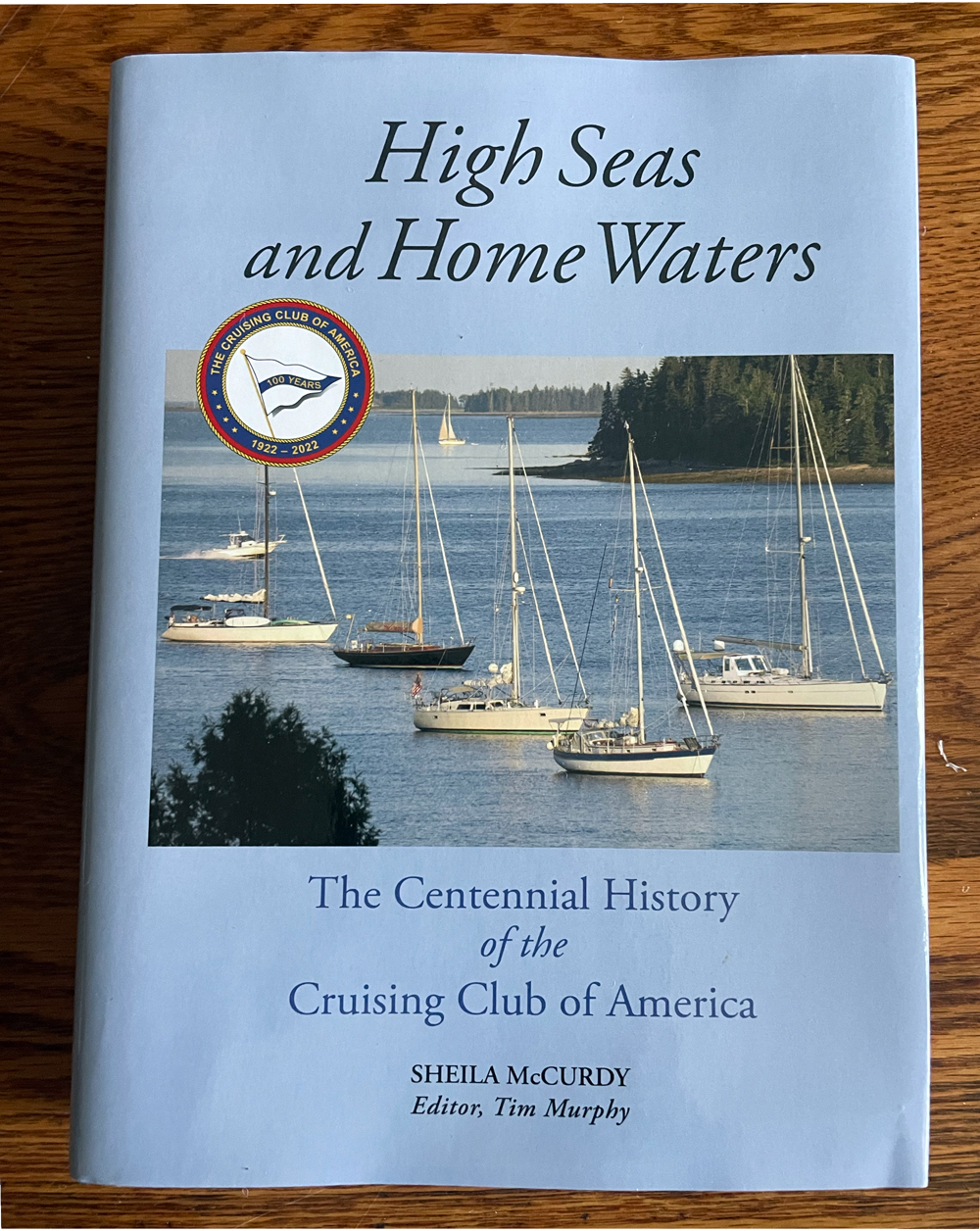
My favorite reading experience is to “live” through a period of history narrated by characters of the era. Usually that leads me to historical fiction, but recently I picked up an actual history that accomplishes the same goal: High Seas and Home Waters, by Sheila McCurdy. Learning about the first centennial of the Cruising Club of America provided both big-picture perspective and juicy tidbits about specific voyages, all shared by cruising and racing sailors making what the CCA likes to call Adventurous Use of the Sea.
Timeless themes
The CCA was first formed in 1922 and has always kept excellent records. We learn which members served in World War II, who stepped up to be commodore every two years, and which boats won the Newport Bermuda Race. While it would be easy for Sheila—a former commodore herself—to focus on the minutiae of running the organization, each chapter includes significant voyages and member accomplishments.
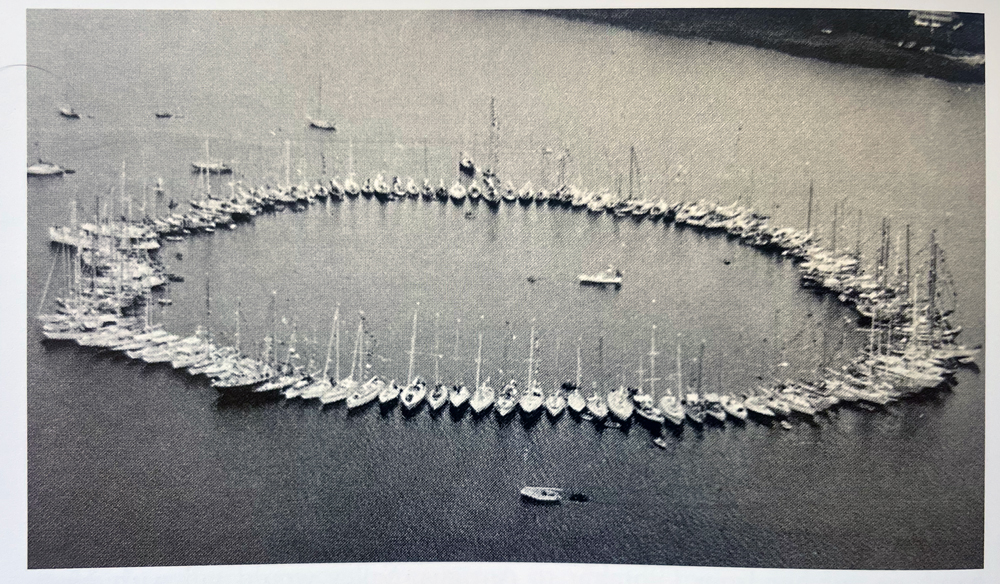
Along the way, several themes provide continuity: the endless seagoing balance of risk vs. reward, the battle between prioritizing racers and cruisers, and the conflicts that sometimes arise between seamanship and socializing. I couldn’t agree more with the caption that accompanies the photo below: “The sunflower raft has been a tradition on Cruising Club cruises since 1963. Creating a raft of myriad boats in a circle requires acts of excellent seamanship for what can possibly be called a completely un-seamanlike endeavor.”
Peeking inside a private club
CCA membership is by invitation only, and parents are not allowed to propose their own children—but they are encouraged to write letters of support. For me, the book’s most humorous moment is the letter Sheila’s father Jim McCurdy (yacht designer and former CCA commodore) wrote for her in 1994. It was the first year women were accepted as members; only eight years earlier, an older member had opined—in writing—that letting girls in would be “a terrible idea.”
After stating that he wrote with enthusiasm, Jim McCurdy went on to describe his first sail with Sheila, “on a weekend cruise when she was three months old and not much use on a boat. This has improved with the years . . . . now she has made many more ocean passages as skipper than I have.” He closed by adding that his daughter “is a thoroughly nice person to have around in fair weather and a very comforting companion when things go wrong.” (I’ve only spent time with Sheila on dry land, but I definitely agree.)
Recommended for
Sheila’s sunny personality warms what could be a dry history, especially once she reaches the 1960s and her own memories become relevant. And the occasional first-person anecdotes help to make this book more friendly and personal than its planned author (historian John Rousmaniere) might have achieved.
I do wish the entire book had received an extra round of proofreading to catch several omitted words and other typos. But those errors do not detract from the story—and many readers probably won’t even notice. I’m glad to see it out in the world, because it might be the only time non-members are allowed to peek inside the CCA—a more welcoming and inclusive organization than its traditional reputation.
While most of this book’s historical details will be too deep in the weeds for all but the most devoted sailing history buffs, I recommend it for anyone curious about 20th century sailing—and the characters it attracted. It is available for purchase in the CCA bookstore, and there’s even a package deal with its sister publication, Adventurous Use of the Sea (written by Tim Murphy, edited by Sheila).
Got a book that offers historical perspective through a unique lens? Share it in the comments below, or send me an email. I read every single one, with gratitude. See you next Thursday.