By the time you read this, my new thumb joint and I should be on the road to recovery after out-patient surgery. (Dig into the gory details by searching for “CMC arthritis.”)
One of the causes of this particular injury is being female and over forty: check. Another is wear and tear, likely exacerbated by all of the wire (and rope) I spliced in my twenties and thirties. I’m very right-hand dominant, so it’s not really a surprise that my left thumb is still (dumb and) working fine.
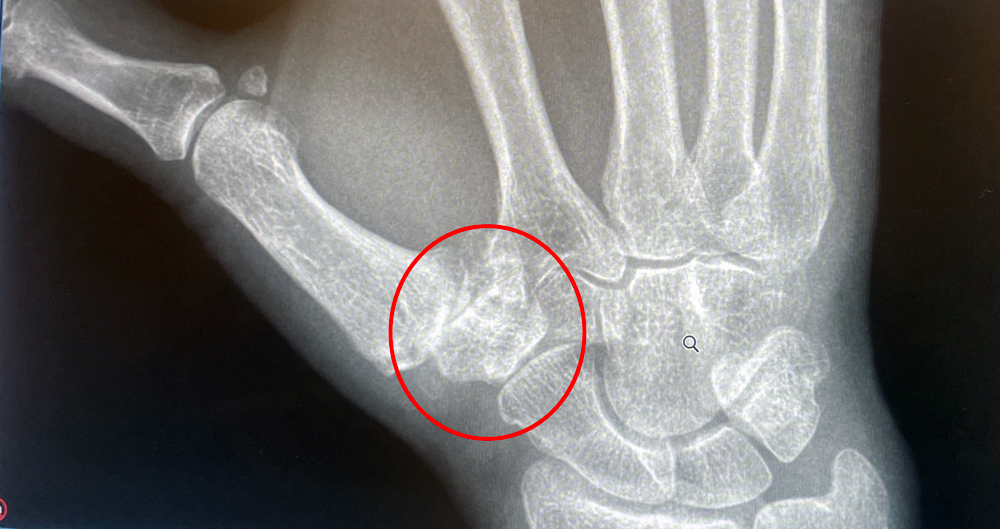
I first noticed the pain and declining grip strength about four years ago, and as it gradually worsened I tried all of the less invasive fixes: occupational therapy, various braces, steroid shots. By last May I was either avoiding the most thumb-aggravating activities (gardening, sewing, downward-facing dog) or in pain for a few days afterward. And while I was still able to enjoy racing Snipes and wingfoiling, rolling sails and donning wetsuits grew more and more painful.
Everyone I asked who’d had a similar problem said “just get the surgery,” but I didn’t want to lose the summer. Instead I started mentally preparing for a physically limited fall/winter—and searching for a well-respected hand surgeon who could build Thumb 2.0.
Luckily I found one locally who understood my priorities, and she described the process (a trapeziectomy) with hand-drawn sketches that were pleasantly personal. After removing the small bone at the base of my thumb joint, she described the new cushion that would fill in that gap: a coiled-up tendon from my forearm (there are two). After a month or so in a cast and a few more months of occupational therapy, Thumb 2.0 should be (almost) as strong and agile as the original model. We set a date, October 20.
By the end of August, I was starting to drop things—including the tiller extension, causing a memorable crash tack on the last day of the Snipe North Americans. So the timing was right, and Tuesday’s surgery was apparently quite successful—thanks in part to the hundreds of times she’s fixed this problem before.
It will be a few weeks before Thumb 2.0 can type again. Since I have no idea how well my dumb left hand will capture all the thoughts and ideas that usually pass through both sets of fingers, I’ve cleared my work schedule and teed up blogs for the next several Thursdays. With luck, you shouldn’t notice any difference.
And I can still read your comments… so feel free to leave one below, especially if you’ve ever gone through something like this! Either way thanks for reading; it’s what keeps me inspired to continue this weekly blog.
See you next Thursday.
Take the time you need to heal properly. The rest of your life with a good thumb is waiting for you!
So glad you got the surgery. Life with that kind of pain and incapacitation is miserable. Just rest it and do whatever exercises you’re given, and you’ll be in racing and foiling condition, not in “no time,” but soon enough to feel the difference. As to typing, try dictating. The early attempts may require some aggravating editing, but your computer will “learn” and get marginally better. I’ve seen computer geeks type with parts of both hands and use the space bar with either thumb. You might be more ambidextrous than you think!! Sending healing hugs.
You made the right call Carol. I’ve had similar surgeries on a wrist and elbow, due in part to playing too much guitar! My results were remarkable and you won’t regret it. At least, our mutual aches ‘n pains came from doing what we love.
Hey Carol, glad to hear you’re getting it fixed! I broke my thumb (along with losing a knuckle from my ring finger) in a foiler accident a few years back. Two surgeries to fix it (put pins in, let heal, take pins out.) And I did about 6 months of hand therapy afterwards. A few suggestions from my experience: 1. Find a great hand therapist. I first tried with regular physical therapy since there’s a place near my house, but they themselves told me to find a hand specialist for therapy. I drove an hour to her 3 times a week for months and it was worth every minute and penny. My hand works almost as well as it ever did. 2. It’ll hurt, but it’s worth it. Just say you need to get a little philosophical about the pain. It’ll go away. 3. The surgeon told me that, at least in my case, 95% of the motion I would ever have would be what I had at 8 months. So it’s worth focusing on for the first few months of recovery and working hard at in. 4. In my case it doesn’t move like it did before I broke it, but I figured it out. You’ll be amazed how adaptable your brain is. 5. Medical professionals who work on hands are all excellent. It’s apparently very hard to get into the field. So they’re all some of the best. Use them to the fullest. 6. They all encouraged me to get my hand moving as much as possible as soon as possible. Obviously, listen to their advice, but push yourself here, it was worth it.
I first got back on a dinghy about 5 months after the break. It took about a year to be where I’m confident doing a hand switch with a sheet and tiller on an A Cat or dinghy. And I’m still a little shy about ducking on port tack when I’m going fast (no close ducks for me, I give space to the other boat for fear of dropping the sheet). But at this point, I barely notice it. And I almost never drop the sheet or tiller anymore. Probably no more than I did when I had two good hands.
Away from sailing, the biggest difficulty was typing. I had to re-learn how to type, but I was also dealing with a short, not nimble, ring finger. Had to figure out how to type A, S, and D different from my high school typing class! But I figured it out. In the meantime, try some of the speech recognition software. It’s very good now, and much better than it was when I was recovering. I’m using something called Fluid Voice on a Mac, and it’s excellent at the right price. You do have to do it differently than typing, where you think on the fly. You have to think through what you want to say, then dictate it. Takes getting used to, but the software is excellent now. Pulls out uhm’s and ahh’s and other filler words automatically.
Driving, once I got confident with my hand was also a bit of a challenge. I found my hand got cold much earlier than it used to. I played Michael Jackson and wore one glove for a long time. If your car happens to have a heated steering wheel, use it. I never even noticed it before, but I still use it regularly (even in Key Largo! lol). I used a steering wheel spinner knob for a while. The hand therapist was worried they can cause other accidents, but it was really helpful. Just drive carefully. Especially since the therapy goes on for months and it’s hard to impose on others to drive you around for that long.
Just a little splash of reality, but all in all it was not a bad experience. At least when there was pain I knew I would be better for it in a short time.
Be careful, at my appointments with the hand surgeon my wife figured out she had a wrist issue he could fix. I ended up driving her to the hand therapist for a while after her surgery a few months after mine. Hopefully it’s not contagious in your house too.
Hope to see you showing off your new thumb down here in February!
Hands are amazing! We take them for granted but when they fail, the impact is noticed everywhere. I was interested in all the other comments. I’ve not had a hand issue, but a repaired ACL left knee when I was 28. All the same things apply – do your exercises, work hard, and you’ll get your function back. Not quite the same – original equipment is always better – but different and still good. I hope for the best for you in this – buckle up for some different work ahead! And I agree with dictating software, just put the punctuation in and you’ll be fine. Peace!