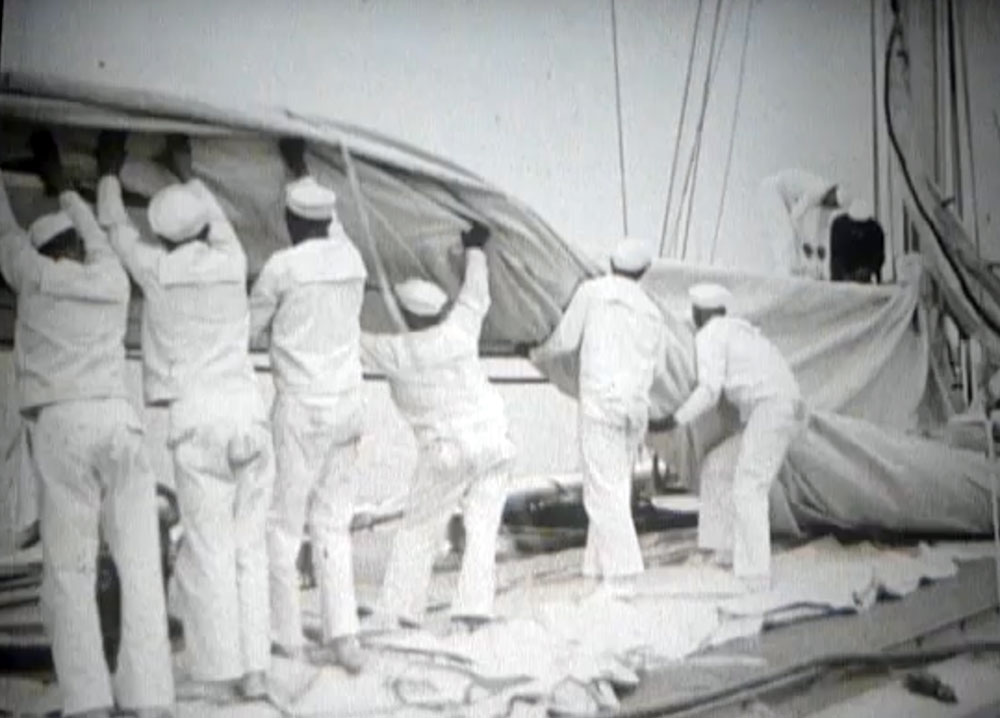
A recent research rabbit hole led (as they do) to two unexpected and unrelated discoveries, both buried in the files of the Rhode Island Historical Society. One was a silent movie documenting the 1937 America’s Cup summer; the other was an even earlier log book from a long-forgotten sailor.
Though there’s nothing like actually seeing manual labor and hearing voices from the past, I was even more entranced by the handwritten log book. There’s a unique satisfaction to holding primary sources, and the entries took me right back to the summer of 1904.
Just like today
Coastal cruising records have a timelessness that more significant history lacks. Narragansett Bay’s seabreeze might not be quite as strong or consistent today, but it still fills in surprisingly fast—provoking disagreements between captain and crew about how much sail is appropriate. And if we squint out the newer houses, a sail down the Bay in 2026 will feel far more timeless than the equivalent car trip, speeding down either side of the Bay and over the appropriate bridges.
Best of all, the camaraderie of sailing will never be improved by electronics and fiberglass.
The log book covers the sailing adventures of two different yachts, Comfort and Asahi. Both were owned by Kenneth F. Wood, and since they were moored in the Warren River neither could’ve been terribly long or deep.
I haven’t been able to find out much more about either, though Comfort was a yawl—and a Captain Davis usually wrote up the log for Asahi, suggesting she was big enough to require a paid hand.
Log books are quite personal, and they can include anything from dry navigation notes to more exciting tidbits about crew activities. Mr. Wood tended more toward the latter, so here are some of my favorite excerpts from the Comfort section. Note: The handwriting is all the same, suggesting that Mr. Wood wrote about himself in the third person (with tongue very much in cheek).

1904
Saturday, May 28: “Coming down [Narragansett] Bay we broke the port spreader and repaired it in Newport. Nothing except generous lieing [sic] took place to afford amusement.”
Saturday, June 4: “Captain Wood displayed great seamanship working up the channel with nothing but the fire flies to lay his course by.” They anchored in Wickford Harbor, where “The mosquitos took a rise out of the crew during the night.”
Sunday, June 5: “The Crew were out very early washing down decks owing to a misreading of the ships clock; 6.40 A.M. being mistaken for 8.30. Measures will immediately be taken to prevent a recommence of such a calamity.”
“The Captain again astonished the deep seamen doing shore duty by the able manner which he handed the jigger sheet and wheel with the same hand, using the other to salute a few of his Newport friends on the General.”
“After uncertain breezes—much hot air and little lunch, the anchorage in Warren River was made at 3.30pm. The Captain thoroughly drilled and cussed the crew on the art of putting on the new thousand dollar sail covers.”
Saturday, July 2: “Grand Annual outing of the ‘Sea Wolves.’ Captain Wood, Cook Reed, Mates Howe and Martin left Warren mooring at 2.20 P.M. Much discussion arose regarding the amount of canvas to be carried as it was blowing stiff from the southwest. A compromise was reached by putting in one reef. The Captain held out for two but had to take what the Crew gave him. Motto: Don’t monkey with a husky crew if you want any lilies on your chest at Easter.” Next: “A heavy squall came upon us and the mainsail had to be lowered. The good Ship stood up in fine shape under jib and jigger until the agile crew took a couple of more reefs in the mainsail.”
“Dropping anchor off Jamestown at 5 P.M. in order to show the new member of the crew the land of Josh.” But ashore, they found “Island deserted, hotels worse.”
Sunday, July 3: After one crew returned from his Newport adventures at 2 A.M. “with the aid of a steam launch,” “The Capt’s wrath was great and he sighed for a breeze to put to sea.”
Monday July 4: “We awoke early with the guns of the Fort firing salutes . . . . Fair weather and a great number of small boats anchored in the harbor. . . . Bands were playing the National anthems and everywhere the flag was in sight. Mate Howe sang perfectly ‘My Country Tis of You’ and offered the usual blessing.”
After a sail to Bristol, they went ashore for much feasting and merriment. Returning aboard, “There was a strong wind and tide which made considerable kickup. The Doctor’s brilliant exhibition of rowing twice from the ship to shore in the eight foot dinghy stamped him as a man of iron constitution.”
And here’s one more entry, capturing the first sail of the next season after “one year shore duty.”
1905
“Captain Wood and Mate Martin left [Warren] at 3.30 P.M. under full sail. (That is the boat was under full sail; the crew was under the influence of Moxie*.) The nimble manner in which the Captain and Mate worked out of the Warren River in their oil skins stamped them as being a couple of slippery tars.”
*Moxie was the first bottled soft drink in the US. This probably refers to its predecessor, “Moxie Nerve Food,” a medicinal tonic that may have included cocaine.
History matters
I’m not sure yet whether this research rabbit hole will lead to anything more than a blog post, but I’m still happy I took the time to read through Captain Wood’s long-lost log. By digging him out of oblivion for this short moment, I feel like I’m honoring a fellow sailor: not an America’s Cup owner, just a guy who—like me—enjoyed coastal cruising with friends out of Narragansett Bay.
Got a favorite historical rabbit hole, or primary source of sailing information? Share it in the comments below, or send me an email; I read every single one, with gratitude. Thanks for being here, and see you next Thursday.
Love Captain Wood’s sense of humor, Carol. His asides could have been written today! One question, asked here by an inveterate landlubber:
You wrote that, “Narragansett Bay’s seabreeze might not be quite as strong or consistent today….” Can you expand on this?
Larry, I’m not a scientist but over 50 years of observation (30 here in Jamestown) I have noticed a decrease in both the strength and frequency of summer sea breezes. A scientist friend ties this to climate change, but I won’t try to explain that here.
Agreed Captain Wood’s sense of humor was worth all the digging.
Thx for reading and commenting!